After the fall of Suharto, the freedom of speech had intensively been advent to public-share of Indonesian’s society, which never happened during the reign of New Order (Orba). Unfortunately, democratization process is not that easy to be embodied in this country. Rather than providing the equal and effective public-sphere which is able to accommodate any fragments of society, reformation era merely affords a free-competition public-sphere in which the dominant and repressive power is capable of intervening public policy. As a result, the freedom of speech has been a utopia because the discourse built has fiercely been polluted by vigilantism.
The university, where the freedom of thinking should be respected, is not immune from religious vigilante group that impose their own religious understanding to the member of the university and academic activities. During 2016-2017, there 18 cases about the academic activities restriction in Indonesian university and the most of them regarding religious issues.
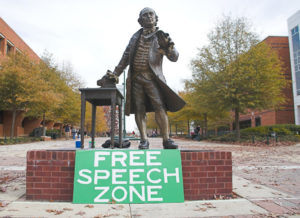
I would like to argues that the deficiency of democratic values in campus, academic malfunction, and misleading conception of the nature of university construct basic conditions for religious intolerance proliferation in various Indonesian universities. We should not pay attention excessively to radical religious doctrines that commonly regard as a cause of religious tolerance, rather we need to scrutinize why freedom of expression was difficult to be implemented effectively in the campus.
We are the witness for recent cases of how tolerance and freedom of speech in the academic atmosphere have been ruined by vigilante groups. Due to of it, what we need to do is to reveal the historical contexts that made those kinds of crudeness have been continuing in Indonesian universities. The corrupt bureaucracy and distorted education system are prerequisites for the emergence of academic freedom restriction. Both conditions must be explored more to apprehend the situation. Forming critically internal reflection will be more valuable instead of blaming exogenous factors.
The university, where the freedom of thinking should be respected, is not immune from religious vigilante group that impose their own religious understanding to the member of the university and academic activities. During 2016-2017, there 18 cases about the academic activities restriction in Indonesian university and the most of them regarding religious issues.
I would like to argues that the deficiency of democratic values in campus, academic malfunction, and misleading conception of the nature of university construct basic conditions for religious intolerance proliferation in various Indonesian universities. We should not pay attention excessively to radical religious doctrines that commonly regard as a cause of religious tolerance, rather we need to scrutinize why freedom of expression was difficult to be implemented effectively in the campus.
We are the witness for recent cases of how tolerance and freedom of speech in the academic atmosphere have been ruined by vigilante groups. Due to of it, what we need to do is to reveal the historical contexts that made those kinds of crudeness have been continuing in Indonesian universities. The corrupt bureaucracy and distorted education system are prerequisites for the emergence of academic freedom restriction. Both conditions must be explored more to apprehend the situation. Forming critically internal reflection will be more valuable instead of blaming exogenous factors.
Komentar
Posting Komentar